Skip to content

Posts tagged ‘Henri Cartier Bresson’

# 5 GABI BEN-AVRAHAM, Tel Aviv Street Photographer
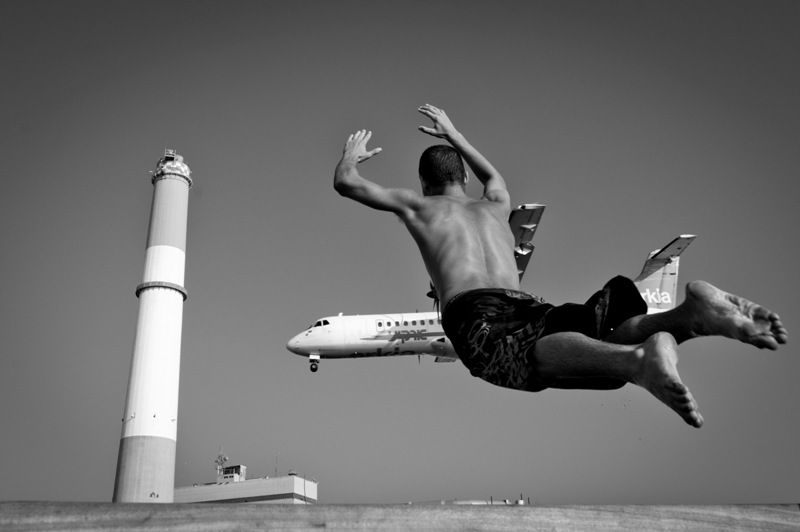

Leica Liker is pleased to have Gabi Ben-Avraham, as our #5 guest.

Social Media has enabled everyone to connect with others to share common interests. That’s how I have been able to see a lot of amazing photographs and ‘meet’ wonderful photographers. But as you know, there is no filter. Everything is game. What you get together with the good is quite a lot of bad. Two sides of the coin.

When Gabi’s photos popped into my news feed, I had discovered something special. I was immediately taken away by his empathy with humanity – in whatever form it came. He modestly says it’s looking for the surreal juxtaposition in life. There’s definitely more than just that.

Gabi is a quasi, self-taught photographer living in Israel. Quasi in that he took some courses in commentary and photojournalism as well as the 101 of digital photography. Like, how to use the menus, EV wheels, and so on. However, he never studied art, yet he has a great sense of composition and light in his photographs.

Most importantly, Gabi has an innate ability to capture the ‘joie de vivre’ of any situation. He has no hesitation to delve into the lives of strangers. Just look at how close he can get in someone’s face. He has a skill I envy. I’ve never seen him photograph but you see from the images he loves to share the lives of his subjects and deeply respects them.

Gabi’s work is not well known compared to the photographers whom I have interviewed so far. But his photographs always garner a lot of praise within the small loyal Facebook Group communities he belongs to, who eagerly await his posts. In my humble opinion, I hope this interview will bring the well deserved attention to his worthy work.
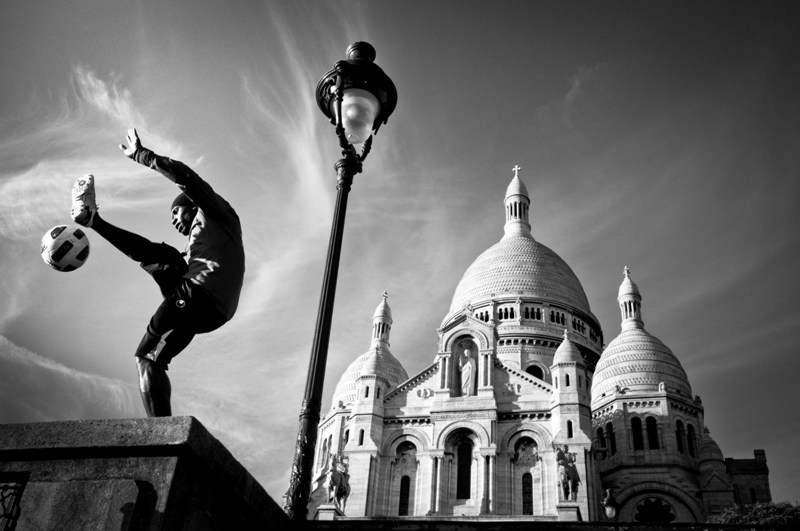

Here’s my interview with GABI BEN-AVRAHAM:

Nick Name: None that I know of.
Currently living in: Tel-Aviv, Israel
Motto: Try capturing the decisive moment that’s beyond reality.
Profession/Job: IT Manager

Street Photographer since: I use to photograph with a film camera during the 1980’s after I came out of the army. But then I didn’t touch a camera for 20 years until 2009, when my wife decided that I needed to get back to photography. She bought me a Nikon D90 and just like that, I returned to my old hobby in a very strong way.
Websites: www.gabibest.com and I also use Facebook to share my photos.
Organizations or Group: Street photography Facebook Groups


Favorite Street Camera & Lens: Body – Nikon D-700. Lens- most of the time I use Nikon 28 mm/2.8 mm prime lens and Nikon 20mm/2.8 mm prime lens
Back-up Street Camera & Lens: Body – Nikon D-90, Lens Nikon 16-35 mm
Favorite photography gadget: None
Favorite street food: Meat sandwich and a pint of Guinness.


Do you listen to music while shooting? No, I prefer to hear the street sounds in order to complete the street feeling.
Favorite music when shooting and/or editing photos: I love to listen to classical music, particularly Mahler, when I edit.
Favorite photo software: Adobe Lightroom 3.6


3 Favorite Master Photographers: Henri Cartier-Bresson, Raymond Depardon, Robert Capa
3 Favorite Contemporary Photographers: Alex Webb, Bruce Gilden, Matt Stuart
Which 3 photographers’ prints do you own? None, but I own books such as: “A Year in Photography” by Magnum, “Street Photography Now” and “The Great LIFE Photographers”


Color or Black and White? I prefer B&W. I add color only when it’s meaningful.
Shoot Film or Digital? Digital. Because I believe in progress. Film is for nostalgic reasons and it expresses the connection to “classic” photography.
Is there a special time of the day you like to shoot or is any time good? Because of the strong sunlight in Israel, I prefer the morning time or afternoon as the light is better and the shadows are longer.

Why did you choose Street Photography and not another form of photography or stamp collecting? I love taking photos of people in urban surroundings because there is always a story to capture. The street is not a studio. It has life. Things constantly change. Sometimes I stand and wait for things to converge – a cyclist, a dancer, a child – moving along. They are not aware that they are moving towards a certain object, but I am.

Street Photography is my favorite way of looking at the world. My camera has become an integral part of me and I cannot imagine myself without it. Everywhere I go I take it with me thinking ‘maybe today will be my lucky day and I will take the photo of my life’. I am constantly looking around me through the camera lens, searching for that ‘decisive’ moment that will never return – unless I catch it.

When pushing the button, I try to make some sense – restore order to the chaotic scheme of things in the composition. The components ‘speak’ with each other in a special dialogue, either by color, shape, or light. Capturing the elusive, special moment after which things will never be the same and making it eternal – that is my goal.
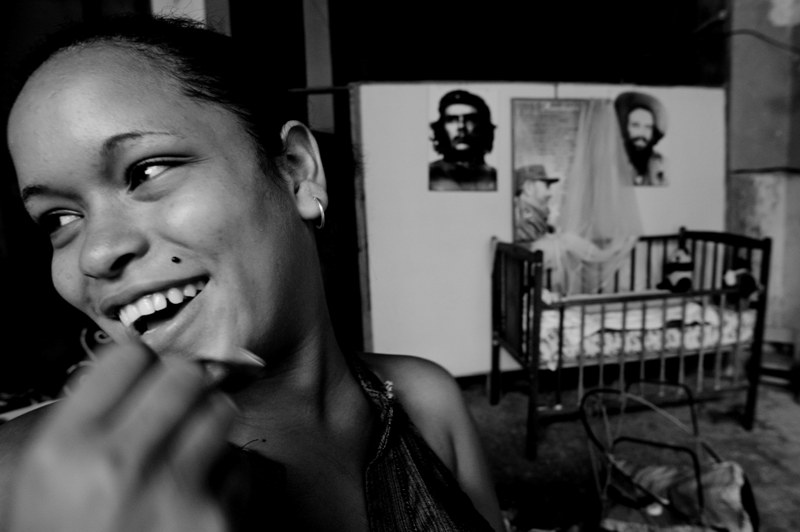
Forgotten, transparent people in urban surroundings are being granted their moment of grace. The shadows, fragile outlines, reflections of daily lives that are not noticed in the busy and thick urban landscape and sometimes are even crushed by it – these are precious to me. Those expressions, compositions – flickering like dim lights on the horizon – I treasure these before they are lost in time.

What motivates you to photograph the streets? The story behind the scene, the surrealism hiding amongst us.


Is Street Photography an escape or an obsession?
As I said, my wife was responsible for getting me back into photography. By the way, her name is Gaby too. 🙂 I think she might regret it because on weekends, I am wandering the streets for up to 12 hours. It’s become an obsession: an excuse to meet people and the city. It fulfills me more than my regular routine job. I work 5 days a week, waiting all the time for the weekend, to get out and photograph.

Are you a loner or can you shoot with friends of a group? Loner.

Favorite street photography city: Tel-Aviv is my home field for street photography. I’ve lived here all my life. It’s a great city. We call it the “state of Tel-Aviv” because it has a lot of atmosphere and a lot of people. It’s a modern city of pleasure, contrary to what the world thinks of Israel. Everyone knows the Old City of Jerusalem. I also like this city very much because it is the junction of three religions. It’s excellent for street photojournalism.

As for abroad, I adore Paris – the classic city for street photography. I just got back from a trip to Havana. I shot so much I was exhausted when I returned to Tel-Aviv. In fact, every city offers its unique surrounding for street photography.


What inspires your photography, including any philosophy? Classical photography and my imagination. As for philosophy – I don’t ascribe to any.
What do you look for in a good photograph? I look for a combination of a good story, excellent composition, reciprocal relationships between the segments that create connection or contradiction. And of course wise usage of light, shadow and color if the photo is in color.

How do you go about shooting a street photograph?
I often choose the location by looking for the right light.  I love to use shadows and reflections. I sometimes wait for 1/2 to 1 hour for something to occur. If you want something to happen, maybe the color of dress, or composition, or you are patient enough – it will happen.

When you compose, what are you looking for?
Take a look at the photograph with the ominous hand waving ‘no’ over smokers walking by (below). I stood there for a half hour and sure enough, it happened. In this case, I had the preconceived idea of stronger hand, teaching or telling something.

I also like high contrast.  I use color especially when it has meaning. Sometimes I change the color to b & w. I often view in black and white.
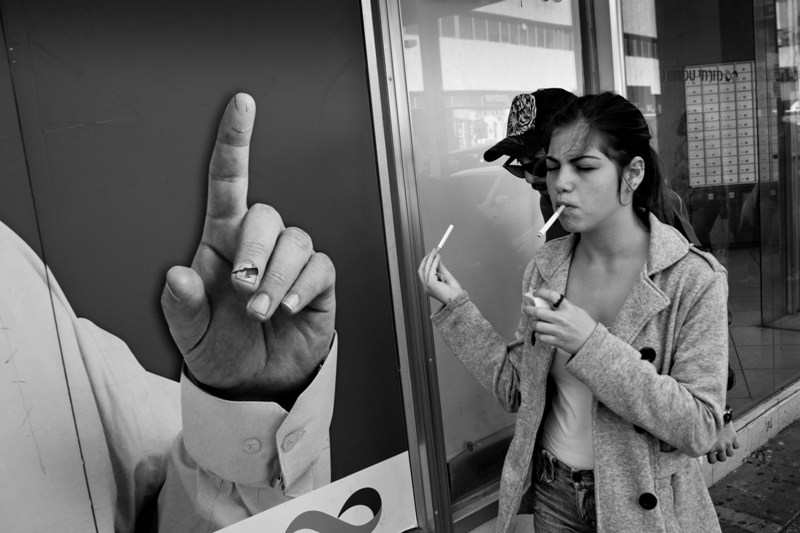

What are you trying to achieve when you shoot? I try to frame a surrealistic moment differently than it appears in reality: Another way of looking.

Best 3 tips for shooting the streets:
1. Find the story behind the scene, using a wide lens.
2. Establish connection or contradiction between the objects to create a surrealistic impact.
3. Use light and color to strengthen composition and story.

Best single advice on how to improve your work: Be open to critique from people whose opinion you value. Do not fall in love with your own work. Learn to be cruel and selective when necessary.

Best single advice on how to edit your work: I object to heavy editing in the street photography genre. Or to making changes in photos. This is the reason why I don’t use Photoshop. Instead, I try to imitate the classical dark room methods by using “Lightroom” and edit only with parameters such as exposure, contrast and brightness.
Best single advice for someone who wants to get into street photography: Create your own style – personal signature and stick to it.
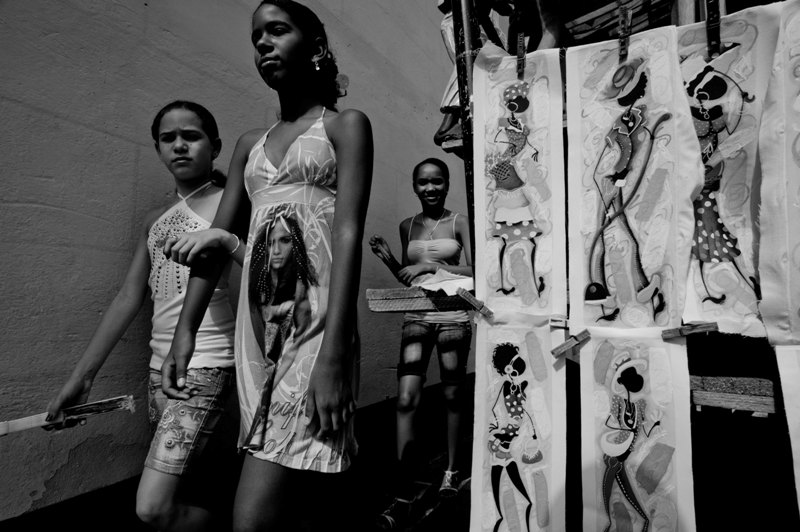

What’s the best moment in your street photography career? Until now I have not had any specific best moment. The best moment will hopefully be when I catch the photo of my life.
What’s the worst moment in your street photography career?
Sometimes, after a while, I cannot find any good photo within all the ones I’ve taken.


What projects are you working on? I made the “Social Protest” project with regard to the temporary tent city in Tel Aviv last summer. Currently, I am making a series on ceremonies, cult and religions all over Israel.
Where do you want to be in 5 years with regard to street photography? I wish to achieve recognition and be one of the best!
Are there other exhibitions planned in the future? I have exhibited my work at several group exhibitions. But right now, I am busy preparing my next project about religions in Israel.

Leica Liker thanks Gabi for sharing his experience and inspirational advice with us. 🙂 We look forward to checking in on him when he finishes his ‘Israel’s Religions’ project.

You can check out Gabi’s gear in Liker Bags’n Gear here.

This is Gabi’s self portrait.

#4 CRAIG SEMETKO, Los Angeles Street Photographer

Leica Liker is honored to have Craig Semetko, a published (LL’s first) Los Angeles Street Photographer, as our #4 guest.

Craig is a super busy man these days. It was hard to pin him down because he is in the middle of his new project, ‘E PLURIBUS UNUM’, which entails driving all around the United States compulsively looking for the ‘decisive moment’. But when he had to come back to Los Angeles to do a comedy gig, I was able to squeeze out a few hours with him at Mel’s Diner on Sunset Boulevard. Craig is a real trooper. He was a little under the weather but didn’t cancel me. “The show must go on!”

After a few gulps from his cup of hot tea and honey, he was raring to go. All our talk about photography, people, life, cameras, and politics made him quite animated. I was thrilled because you couldn’t stop him. ☺

When I first embarked into street photography, I scoured the internet and bookstores for information and images. I came across the stable of master street photographers  you’ve all heard of, as well as Craig’s work. I also had the good luck to see his images printed and meet him at a solo exhibition at the Phil Stern Gallery here in Los Angeles.

What caught my eye in Craig’s work was his sense of humor in so many of his street photos. They were classically composed, each with a story to tell and harked back to the photos of Elliott Erwitt and Henri Cartier-Bresson. Then I learned that they are his heroes. Funny how that is.

Craig talks about depth in his photos: Depth coming from composition, content and emotion. With today’s digital photography and social networking, countless photos are taken and shown without consideration of these elements. But this self taught photographer strives very hard to achieve all three points. Together, these points always lure me in: like fish to bait. I want to know more. I always laugh or cry with the subjects in his images. They have sentiment but aren’t sentimental for sentimentality’s sake. And they often leave an indelible impression. That’s why I can remember so many of his photos, while others I forget immediately after I look at them. In my eyes, that’s a sign of a master in the making.

You can see many of Craig’s classic images in his first book “UNPOSED,” published by teNeues with a foreword by legendary photographer Elliott Erwitt. It was released worldwide in late 2010.

Here’s my interview with CRAIG SEMETKO:

Nick Name: None that I’m aware of. Maybe people call me things behind my back.
Currently living in: Los Angeles. But I have been traveling throughout the United States for the past year and will continue through the end of this year.
Motto: To quote Hunter S. Thompson: “ When the going gets weird, the weird turn pro.”
Profession/Job: Professional photographer and comedian.

Street Photographer since: Since 2000, when I went to China on a business trip and thought I should bring a camera. Prior to that I didn’t own a camera.
Websites: http://semetko.com and http://semetko.com/blog/
Organizations or Group: I don’t belong to any group that would have me as a member.

Favorite Street Camera & Lens: Leica M9 and Summilux 35mm f/1.4 (used most often) and Summilux 50mm f/1.4 lenses
Back-up Street Camera & Lens:
Leica MP. Same Summilux lenses: 35mm f/1.4 and 50mm f/1.4
Favorite photography gadget:
I love the “Thumbs up”. It kind of replaces the shutter cock on a film camera.
Favorite street food:
Any Thai street food.

Do you listen to music while shooting? Only in my head – if I wore earphones I’d get run over. Actually, I did get run over once (I’ll tell you about that later.) The music I listen to is in my head and frequently applicable to where I’m shooting. It’s usually some corny song. For instance, when I was shooting in Savannah, Georgia, I was whistling Dixie in my head.
Favorite music when shooting and/or editing Photos: When I edit I listen to all kinds of stuff-Oscar Peterson, James Brown, Rolling Stones, Ramsey Lewis…lots of jazz, funk and rock and roll.
Favorite photo software: I don’t like a lot of tech because it drives me crazy. But I do like Nik Software’s Silver Efex Pro 2 for black and white photos. As for color, you don’t have to do much to the image when using the Leica. Its sensor has vivid colors and high contrast. So I don’t need to futz too much. I just play with the curves a little in Aperture and Lightroom.

3 Favorite Master Photographers: Henri Cartier-Bresson, Elliott Erwitt and Robert Frank
3 Favorite Contemporary Photographers: Steve McCurry, Peter Turnley and Aaron Huey
Which 3 photographers’ prints do you own?
1) Herman Leonard’s photo of Dexter Gordon
2) John Dominis’ (Life photographer) photo of actor Jackie Gleason and singer Frank Sinatra at dinner.
3) Vivian Maier’s overhead shot of a soldier and girlfriend holding hands.

Color or Black and White? Both.
For the first 10 years I shot primarily black and white because my favorite photographers shot in black and white. Now I shoot mostly color. And I’m getting good feedback on it. I’m evolving.
Black and white is generally more abstract because we see in color. So it’s a challenge when working with color because it adds so many elements to the picture. If it doesn’t jive then it can look pretty bad.
Black and white is a great way to learn photography. It makes you concentrate on the essentials: form, light, story, information and emotion. Adding color can be distracting if you’re not careful. Depends on your interest and style. I’m just working my way through that right now.

Have you looked at Constantin Manos’ work? He started in black and white and moved to color.
Yes, of course. Constantin Manos’ earlier black and white photos were definitely more humanistic. The people were expressive in the pictures. His color shots are more abstract, but they do maintain a humanistic aspect.
When I shoot black and white, I also usually take the humanistic approach. And I’m applying this same approach to my color work. You know, to be conscious of the color scheme in the photo and how it relates to the people and the sensibility of the image. I really don’t want clutter in my photos, which appears rather easily with color if you’re not careful. In general, I have not made an exclusive change from one to the other. Some pictures look better in black and white and others in color. It just depends. By default, I am shooting in color for my ‘E Pluribus Unum’ (Out of Many, One) project. So it is making me think more in color.

Shoot Film or Digital? I started with film but now I shoot almost exclusively digital. When Leica came out with the M8 it was thicker and it felt too big. I didn’t like the feel. And I missed the click of the shutter cock. So I shot film for a long time while people were shooting digital. In 2008 I was commissioned to do some photography work in Los Angeles. I bought the M8.2 and the more I used it the more I liked it. Since then I never looked back. Very rarely do I use film now. My current project, ‘E Pluribus Unum’ is shot entirely with the M9. As I’m taking thousands of pictures, the time and cost of film and processing would be prohibitive. Now I’ve grown accustomed to the M9 and the ability to change ISO for varying light situations. I shoot primarily 400 ISO because I know the exposure from years of using Tri-X. And it’s great to know if I have the picture by checking it instantly.

If Film, what type of negative? I shot just about everything with Tri-X with the occasional Kodak 3200.
Is there a special time of the day you like to shoot or is any time good? For color, I like the golden hour in the late afternoon. With black and white I prefer overcast days as you can shoot anytime and your exposure doesn’t change.

Why did you choose Street Photography and not another form of photography or stamp collecting?
When I first discovered Henri Cartier-Bresson I saw a quote of his that said, “Photography is nothing-it’s life that interests me.” That rung true for me. Taking pictures in the street was just another form of people watching and telling stories.

I think street photography was always a part of me. When I was young, I took drawing and art classes and learned basic composition. Of course I learned a lot more from studying great photographic work.

I’d been a comedy ‘observation’ writer and performer for 20 years before taking any pictures. Comedy is about observing people, characters and life. So is street photography. It was natural that I would pick up a camera and look for people, characters and stories to tell. Comedy is not entirely different from street photography, at least as I see it.

When I went to China on a business trip, I bought a camera and took lots of photos. After seeing some of them printed, I realized I could use a camera as another means to tell stories. And that’s how I started. I looked for drama and characters on the streets. But then I began to study HCB’s photographs, and I realized how complicated his images were compared to mine. He looked for the form first and knew the drama and emotion would follow. This realization made me start concentrating more on composition. I also discovered Elliott Erwitt early. He has a great sense of humor, which strongly appeals to me.

What motivates you to photograph the streets? I want to capture the truth or authenticity of a situation.

W.Eugene Smith, the great photojournalist said, “I’m not interested in the truth of the lens, I am looking for the essence of truth.” For example, take a look at his famous 1958 shot A Madwoman in a Haitian Clinic. In his contact sheets, you see the woman in a room with objects and details behind her. But in his final presentation print, he blacked out the background by burning in the room. He then applied bleach in the whites of her eyes to make them pop. This left a disembodied face that looked freakish. To him it conveyed the truth of the situation: a woman trapped in her own mind. I’m not passing judgment. I’m just saying, it’s about capturing people, life situations and showing that truth.

I gravitate towards the absurd and street photography allows me to find it. I like people to look at my photographs and say, ‘what the hell is that?’ I try to provide the elements of a story and let the viewer fill in the details.

Is Street Photography an escape or an obsession? More obsession than escape. In the beginning it was a burning love, like meeting someone and going through the first phase of lust. Then it settles into a deeper love. I have a different feeling towards it now than when it began. Before it was – ‘I’m going out to shoot.’ Now, it’s my life. It must be a passion or mental illness that is making me criss-cross America for the next year.

Are you a loner or can you shoot with friends of a group? I am a loner when shooting. When I’m with someone I tend to want to socialize or entertain. However, I have grown to see the immense value of having a person with me as an accomplice. I was in Atlanta in a mall with my mother and nieces when I saw an old lady next to Santa who I wanted to photograph. I told my mother I needed her help to get the shot. She didn’t know what to do. I told her to just stand next to me–it made me look less suspicious.
Favorite street photography city: New York! There’s always something weird going on.

What inspires your photography? I’m always reading books, going to museums, listening to music. Rhythm and music inspire me as a comedy writer and as a photographer. Also the work of the masters. I keep copies of books by Erwitt, HCB, Frank and Vivian Meir in my vehicle while I drive around the country.
What do you look for in a good photograph? From others and from your own work?
I look for a sense of geometry, information, and emotion. It has to tell a story or present the elements of a story in a well-composed frame and create some emotion in the viewer.

I expect that from my own photos as well but I am also trying to go deeper. I definitely add humor to the equation. To see something as funny, you have to understand the seriousness from which it emanates. It has to be based on some truth. And I want to show more than just humor. I’ve had people contact me after buying my book UNPOSED to tell me that each time they look at my photographs they see more in them. They might get an immediate chuckle but then they see the seriousness as well – the deeper story. I love to hear that.

I read that you believe photographing does not require too much thinking because it “constipates” things. How do you go about shooting? Thinking can be a problem. When I’m in the moment, I’m not thinking at all. I’m locked in non- thought. The more you think about a shot, the easier it is to lose it. If you’re thinking long, you’re thinking wrong. Sometimes you just have to take the shot.
Best 3 tips for shooting the streets: Be fast. Get closer. Work on seeing. Carry a camera, and be aware of your surroundings. If you don’t have a camera with you, pretend you are a camera and blink your eye at the decisive moment. That will teach you to observe. It will help you start to anticipate your subjects’ movements and learn when to press the shutter.

Best single advice on how to improve your work: Study the masters, not Flickr.
Best single advice on how to edit your work: Have someone else do it. It can be a revelation. I’ll give you an example. My most well known photograph was one I never thought of printing or showing to anyone. I had a photographer friend of mine whose opinion I respect look at my contact sheets. He saw the shot of a man pissing at a urinal with pictures of Marilyn Monroe looking at him and laughing. He insisted I print it. I did, and it is my best selling print. So you can have surprises.

Best single advice for someone who wants to get into street photography: Elliott Erwitt said, “Be an heir and do it on the side.” I believe he was only half joking. It’s a tough road to hoe, so you really have to love doing it. Shoot as much as possible. You have to dedicate yourself to it and go through a lot of shoe leather. Finally, and this is important–try to take pictures that no one else on earth but you could take. This will help you develop a personal style, which is imperative in a world where everyone with a cell phone is a photographer.

What’s the best moment in your street photography career? Every time I press the shutter and know I’ve got a good one. But there is one really overwhelming experience: A friend of mine suggested I show some of my work to a gallery owner in Durango, Colorado. I did, she liked it and told me to stay in touch. I wasn’t very good at staying in touch but six months later she called me saying that she was doing an exhibit of HCB’s work and was wondering if I would like to show some of my work alongside his. You can imagine how excited I was. I remember the day we put that show up and I stood in the corner and looked at the walls. There were 25 Cartier-Bresson prints and 25 of mine. I teared up. I got into street photography and bought a Leica because of him.

What’s the worst moment in your street photography career? I was run over by a motorcycle in Hanoi, Vietnam. It gave me a pronounced limp for a while.
What projects are you working on and is there a theme? E Pluribus Unum – my project about the United States in 2011/2012. I started off wanting to show the polarities in present day America–economic disparities, political intransigence, etc., with the intent of spending periods of time with families at home or at work. Very soon into the project I realized I was drifting from my personal style. People whom I respect reminded me how important it was to not change my style. So now I am very conscious of not altering it. As a result I changed the way I approached this project. I now shoot in the same way I always do–I look for something that interests me and I take a picture. I will continue the project through the end of this year, and then the real work begins–editing!

Where do you want to be in 5 years with regard to street photography?
I hope to continue doing candid spontaneous pictures of people’s lives. And finishing up my third book. ☺ Just going with the flow, seeing where life takes me. And I hope that I am a better photographer than I am now.
Congratulations on the last exhibit you had at the Phil Stern Gallery last October. Are there exhibitions planned in the future? Yes, I’m part of a 6 photographer exhibit entitled ‘OFF THE BEATEN PATH’ at the Robert Anderson Gallery in New York City. I’ll be showing three established photos and three new pieces from my current project. The opening night reception is June 7th and it runs through August 4th. One of the photographers is Geoff Winningham. I’m looking forward to that.

Leica Liker thanks Craig for sharing his experience and the inspirational advice with us. We will check in on his E PLURIBUS UNUM in the near future.

Craig teaches at Leica Akademie Weekend. His upcoming workshop will be on July 20th to 22nd in Venice Beach, Los Angeles, California. Check out Leica Akademie Schedule here for more information.

You can check out Craig’s gear in Liker Bags’n Gear here.

This is Craig’s self portrait. Notice his Leica M9 🙂