
# 10 RICHARD BRAM, New York Street Photographer

Leica Liker is honored to have Richard Bram, a New York Street Photographer as our #10 guest. Also Leica Liker’s third published photographer!
If you don’t already know, Richard is one of the first members of in-Public, the first non-commercial street photography collective established in 2000. And as such, he and his group have helped educate and bring recognition to a photographic art form that is currently enjoying a growing popularity and renaissance. They have forged a path for all of us who want to learn and improve our own vision by establishing high standards with their own work as well as pro-offering the works of masters.
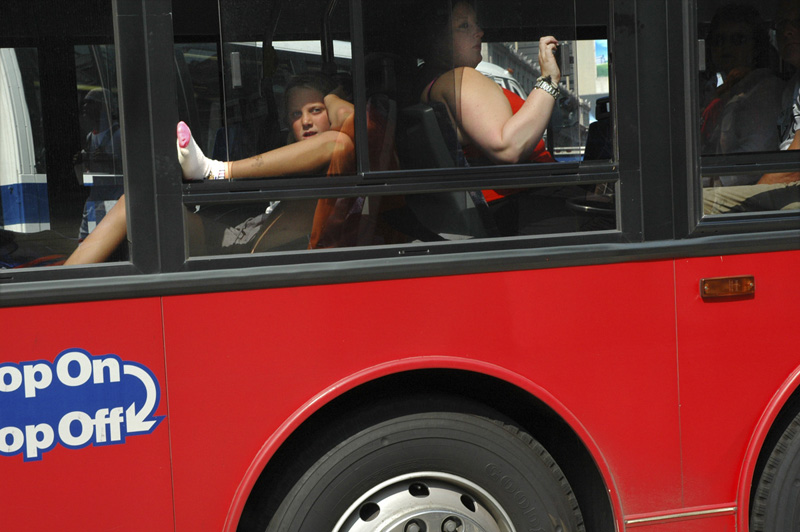
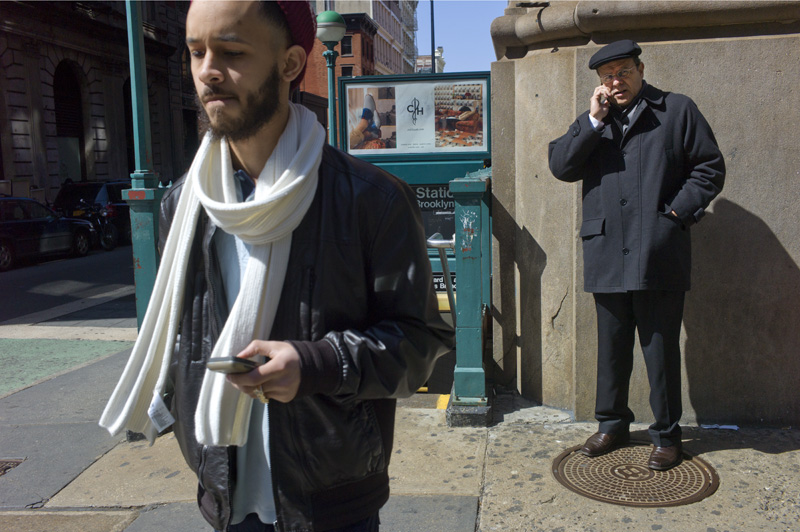
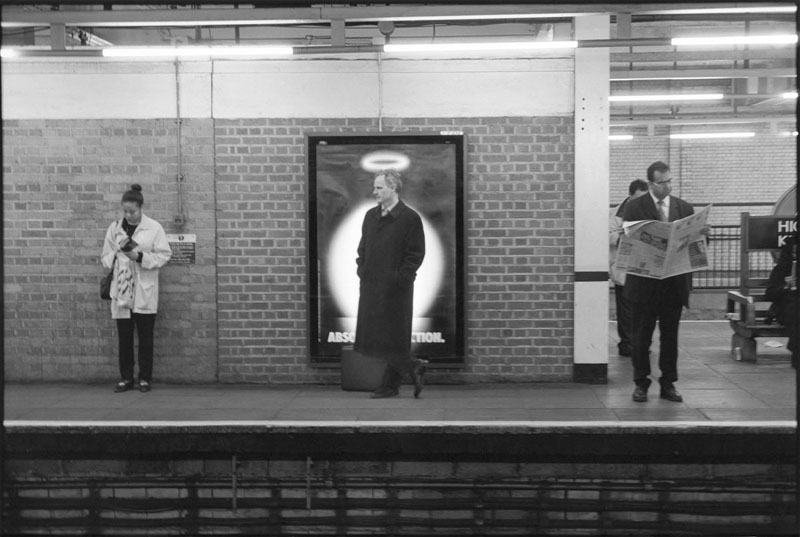
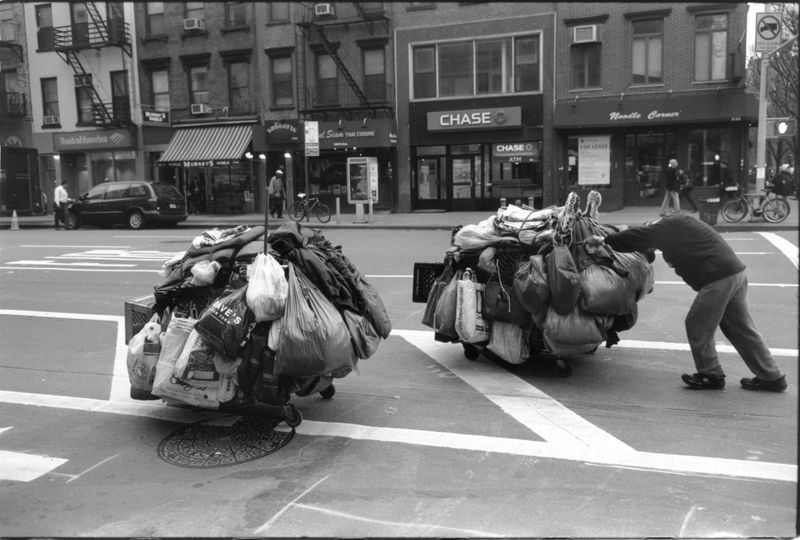
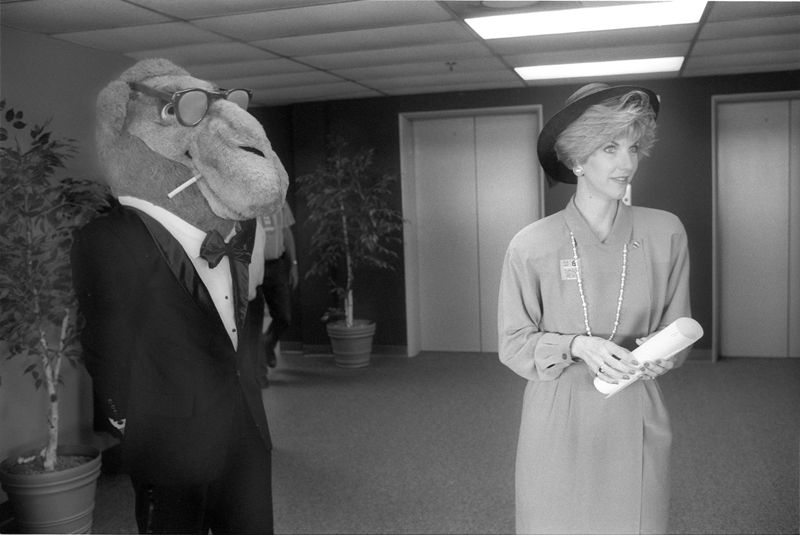
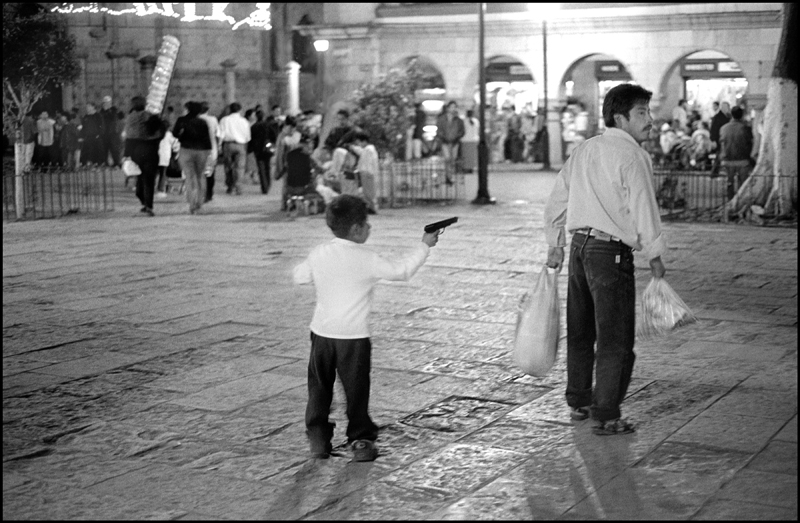
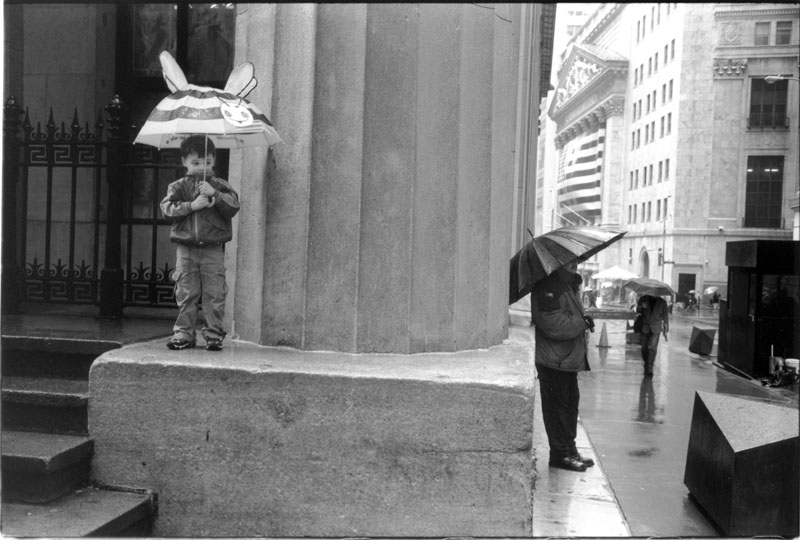
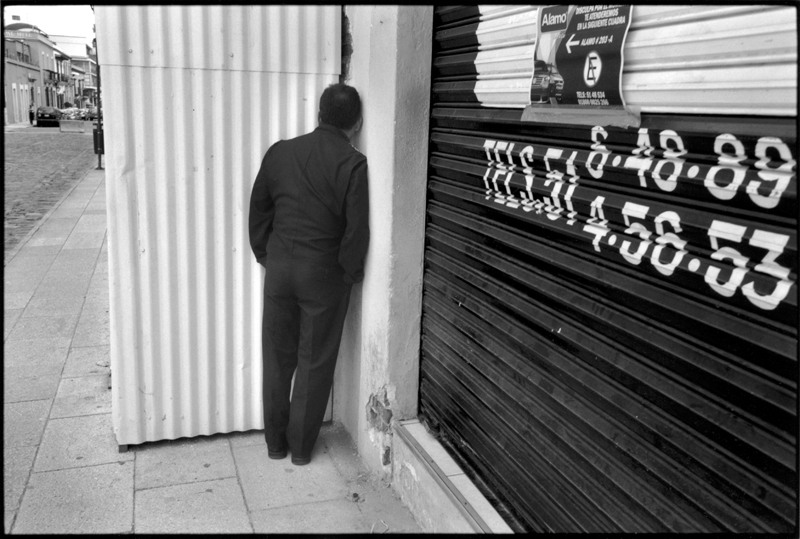
Richard’s work quintessentially defines the ‘decisive moment’, with a dry sense of irony and sarcasm. While many street photographers can capture a funny juxtaposed moment garnering a quick belly laugh, Richard’s images draws you in for a long sustained chuckle that is often thought provoking.

You can’t just scan through Richard’s images. You have to look at them, study them. Like a fine wine, you have to air it, swish it around and then drink it in order to experience its full breath. The juxtapositions are a mixture of simple and complex all at once.
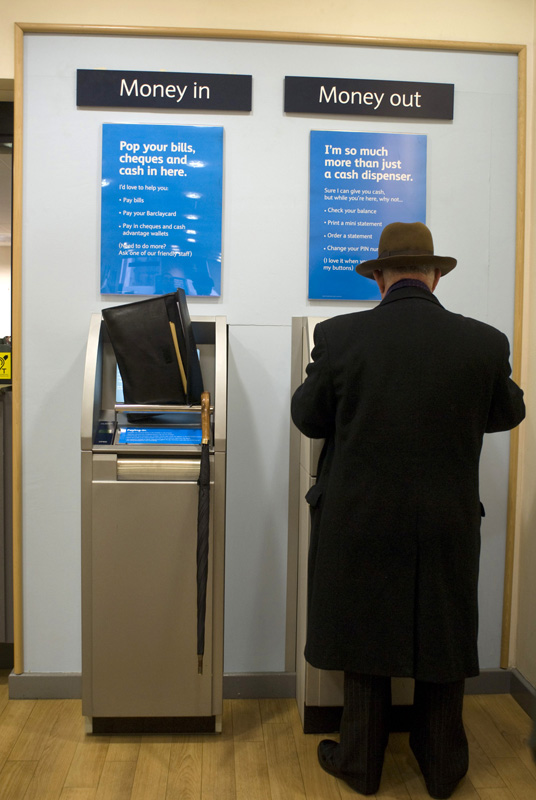
I think the simplest one is the man at the bank deposit and automat (see below). At first glance, a balanced photograph of an interesting conservatively dressed man standing in front of the automat. Nothing out of the ordinary, right? Upon closer look, two signs read “Money In” and “Money Out”. Think about it. We don’t see his face- he’s anonymous. But we know he is older by the way he is dressed, like the typical high-rise office worker- a kind of uniform complete with umbrella and valise. It looks routine: Like he’s been doing this all his life. He makes money every day in his job, deposits it and then withdraws it. Not too different than the automat machines themselves. Like a hamster, going through his motions. It’s his cycle of life. I can continue to ruminate and extrapolate, but you get my point.
Every photograph Richard makes appear simple yet they tell you a deeper story about who we are as humans and how we live in our society. It takes a great deal of life experience to recognize what he terms as the “odd moments” of life. And Richard has had his share of life’s ups and downs: from struggling to survive, to being a successful commercial photographer. You can tell he’s been through it all with gravitas. The result? Those “odd moments” give us an endearing look into ourselves and sets a very high bar of what the ‘decisive moment’ can be.
Here’s my interview with RICHARD BRAM:
Nickname: Photobram on the web, none in real life.
Currently living in: The Financial District of New York City
Motto: “ALWAYS have a camera.” This is not a motto: it’s a Commandment.

Street Photographer since: the mid-1980’s
Profession/Job: Independent Photographer, bookkeeper, secretary, accountant, receptionist, mail-clerk, errand boy, darkroom tech, janitor, and cat-box cleaner.
Websites: richardbram.com, in-Public.com/richardbram
Organizations or Groups: In-Public.com since 2001.
How did you decide you wanted to be a photographer after studying business management and working in US corporations? How were you able to make the transition? Growing up, I was a standard hobby photographer. I realized I wasn’t cut out for the business world: I was on dole for a while, then I got a job as a salesman in children’s wear and moved to Kentucky. When this came to an end when I was 32 years old, I simply lost my head. Armed with ignorance and courage I declared myself to be a photographer. While I had talent, I didn’t know much about photography and certainly didn’t have the craft. I made lots of basic mistakes and pretty much starved for 2-3 years. There were times when I had to decide between eating and buying photo paper and had to buy the paper so I could eat next week.
A few lucky breaks came my way; the biggest was to become one of the photographers of the Kentucky Derby Festival. There were 70 events associated with it and every corporation in the region was involved. After the Festival, they knew me when I called to solicit work. Most of them had regular photographers but they called me when the others were busy. Within a couple of years I had a regular clientele. When you’re no. 2 for enough people you’re always busy and eventually I became no. 1 for many of them. After several years of shooting countless events and headshots, you lose the spontaneity you once had when you started. I started to see uncomfortable moments that occurred around the events I was being paid to shoot. Those moments were far more interesting and the oddity of those situations had a much longer life span than the commercial work.
You’ll never make money as a street photographer, but what’s is important to me is what I do for myself. A few months ago I saw Bruce Gilden shooting portraits for a commercial job. We all have to eat.
Favorite Street Camera & Lens: Whatever I have with me; usually but not exclusively, a Leica M9 with a 35mm f2 lens. Occasionally I use a 24mm f2.8 as well, and once in a great while a 50mm f2.
Back-up Street Camera & Lens: When I feel like shooting black & white, it will be a Leica M6 or my old brassy M3 with a very old 35mm f2 lens with a yellow contrast filter on it.
Why do you use a Leica and nothing else? When I began, I used a Nikon F2. It was solid and rugged with a very loud and distinct shutter clack. I was doing a lot of work with the Orchestra and a friend told me I needed to get a Leica because it’s quiet. In early 1988 I found a used Leica M3 and still use it (see above). It’s light, comfortable, reliable, small, inconspicuous and nearly silent.
I do now use a Nikon D700 for my professional work, but several other cameras for personal shooting, depending on my mood. I’ll go out with a Rolleiflex TLR, Olympus XA, Canon G12, Zeiss Super Ikonta 6×4.5 from 1936 or old Russian Horizont panoramic. It just depends on my whim.

Favorite photography gadget: “Gadgets? We don’t need no filthy gadgets!” Sometimes I do carry a hand-held Sekonic L-308 Flashmate light meter. Keep it simple.
Favorite street food: In New York, street dogs. They’re on nearly every corner.
Do you listen to music while shooting? Never. If you’re groovin’ to your tunes, you are not paying attention to the street. You will miss aural clues to a potential picture. All your senses need to be wide open, not stopped up, all antennas to full gain. Keep the music for when you’re done shooting; you’ll enjoy both all the more.
Favorite music when shooting and/or editing Photos: OK, when editing, I’ll listen to all sorts of music from pre-1960’s jazz to serious chamber music to Tom Waits. (I’m just not a hip-hop guy – too old for it, I guess.)

Favorite photo software: Photoshop CS4, Lightroom 4 and VueScan to run the Nikon film scanner. (Curses upon the complacent Nikon for not updating their software!) Lightroom handles the general work and first level of processing and sorting, then Photoshop does the fine work when I need to get into it. I use the corrections sparingly. I am pretty much a straight photographer, using the software much in the same way that I work in the darkroom, adjusting general light levels and a bit of burning and dodging but not deeply altering or shifting the image.
3 Favorite Master Photographers: What? Only three? OK, if I have to, let’s try this: In chronological order, André Kertész, who discovered a new world; Henri Cartier-Bresson, for whom that world was named; and Garry Winogrand, who left the world behind and went to the Moon.
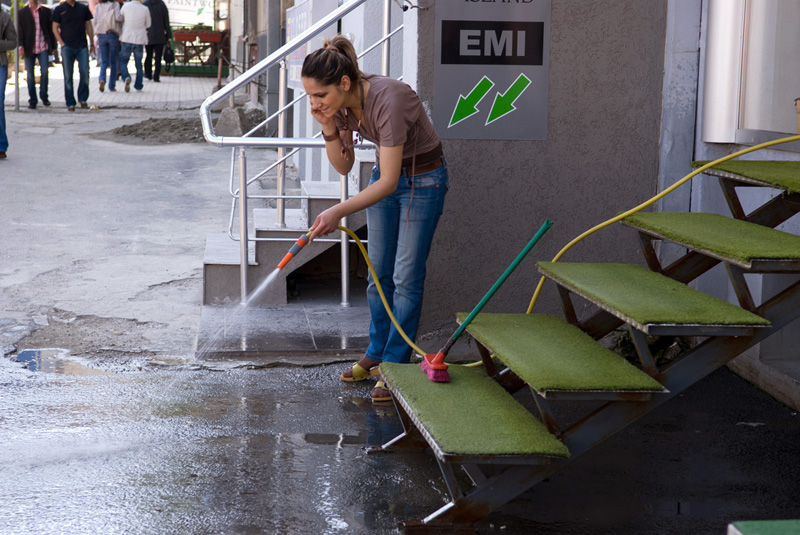
3 Favorite Contemporary Photographers: What? Only three? Now this is an impossible question – there are so many whose work I admire. But let’s try these, in no particular order: Richard Kalvar, a wry and sharp Magnum photographer living in Paris. Many of his pictures are funny in some ways, but there is something very serious in them as well. Christobal Hara: he has the same surreal quality of early Koudelka, only he works in color and in Spain, which becomes an even more strange place through his lens. Third is a ‘collective’ photographer: my colleagues at iN-PUBLiC.com. We all compete with each other in a respectful way, keeping ourselves sharp, critiquing and improving our own and each other’s work.
Which 3 photographers’ prints do you own? What? Only three? Among others, J. H. Lartigue, Grand Prix de I`A.C.F., 1912, Luis Gonzales Palma, Nascimiento, 2004, and for my birthday last May, Orville Robertson gave me the beautiful gift of Whitney Museum, 2002.
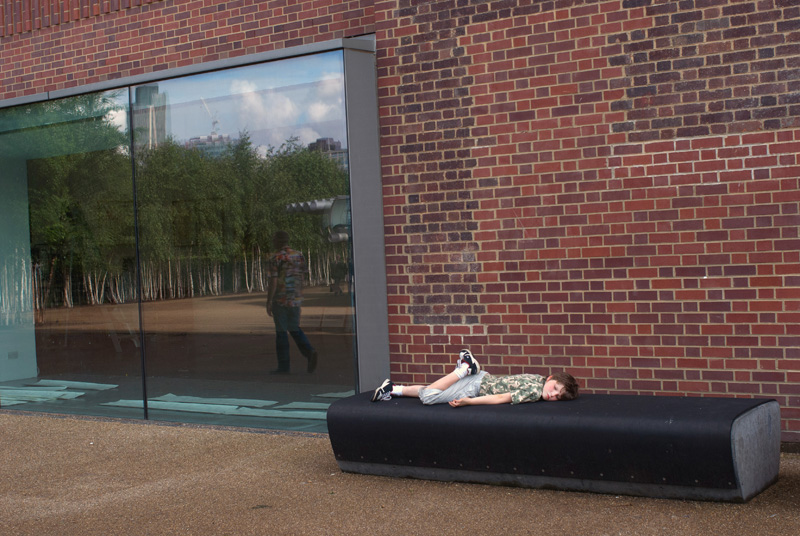
Color or Black & White? Yes. I refuse to be pinned down and I like both – it’s like drawing and painting. I have always shot color in my commercial work since the very beginning. Originally it was black & white that was new. But shooting color intensively in my personal work is relatively new for me, and in many ways I am still coming to grips with it. There are a lot more variables to deal with in color, and a lot more ways in which a photograph will not work. Then again, the photograph can be about color itself, or even a particular color which is fun and challenging. This leads to the next question,
Shoot Film or Digital? Yes.I shoot all my color digitally now. I’ve always printed my own work and one of the frustrations I had was not being able to print my own color. Now that inkjet printers have improved to such high levels, I can sit at my desk in the light and make big beautiful color prints to the same standard that I make my black and white prints in the darkroom. I still shoot all of my black & white on film as I prefer the way it records monochrome tones versus converting an image from a color original.
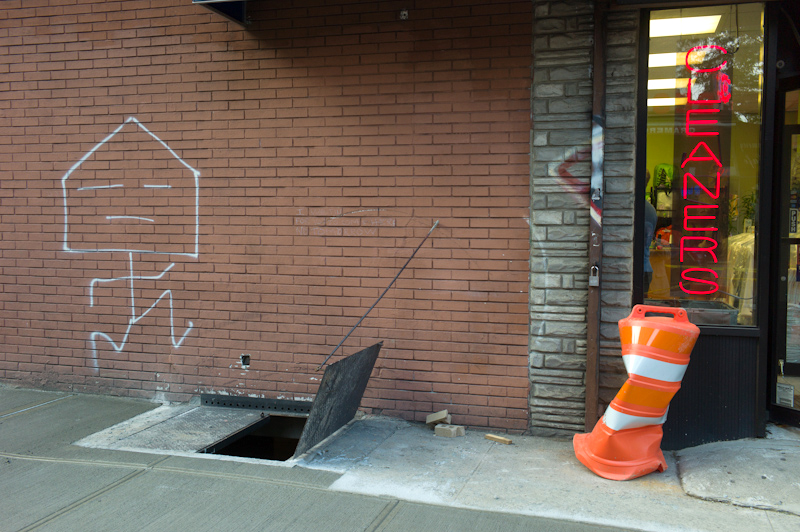
If Film, what type of negative? By this time, 95% of my work is on Kodak TMax 400. I’ve used TMax films since they were introduced in 1988. I’ve occasionally used the 100 and 3200 too, but always come back to 400. Of course, I’ve shot Tri-X, Agfa, Ilford, and Neopan too but I pretty much stick with TMax. I know what it will do, how it reacts to all sorts of light and just as importantly what it won’t do. For me it is all about eliminating as many variables as possible.
Is there a special time of the day you like to shoot or is any time good? As I said, I always have a camera and there are always photographs. However at certain times of day the light might bounce around the narrow grid of Manhattan or along Oxford or Regent Streets in London, and that’s always fun too. Generally, though I do avoid the very middle of the day. It is just a bit too harsh for me. However, bad weather can make great photographs.

How do you define street photography? Well, it has to be an un-posed moment, not set up, something that happens spontaneously that gives you the urge to throw a rectangle around it. Usually it has people in it and usually outside but neither is a necessity. It’s hard to define. I know it when I see it, but don’t know what I see.
Nick Turpin said it really well: A good street photo shows something that people wouldn’t have seen even if they had been there.
Why did you choose Street Photography and not another form of photography or stamp collecting? In my case one could say that Street Photography chose me. I began in public relations and event work. I began paying attention to the interesting or uncomfortable little moments that would take place while I was shooting an event for a corporate sponsor. I would take these photos as well, though not show them to the client. From this grew my interest in the un-posed, un-scripted moments that are the heart of good Street Photography. And what do you have against stamps?
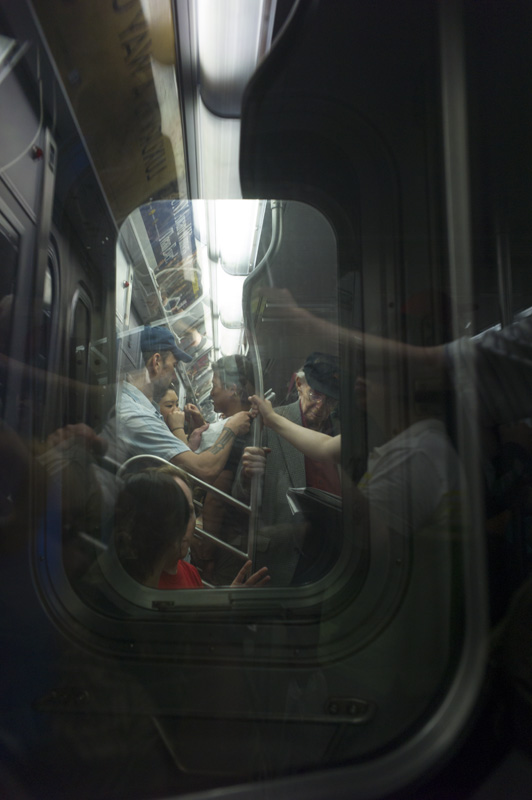
What motivates you to photograph the streets? The challenge and delight of seeing something strange appear in real life, in real time and throwing a rectangle around it. You don’t have to set things up: there is enough ambient weirdness in reality.
Is Street Photography an obsession? Yes. I think it has to be to a certain point, because the hit rate of success to failure is so low. If you’re not obsessed, you’ll move on to something much more controllable with a greater chance of success, say, poker maybe.
Are you a lone shooter or do you like shooting with friends or a group? Alone. I can’t shoot in a pack or a group and get anything worthwhile. Again, it’s the concentration thing. If I’m wandering around with other people, I’m not paying full attention to what’s happening around me. That said, In London I’d occasionally go out with David Gibson, Matt Stuart and Nick Turpin and shoot Oxford Street on a nice afternoon, but we would separate and work different areas, mostly keeping away from each other until the light went. We would meet up afterwards, adjourn to a pub and compare notes over a pint or a meal.

Are you an invisible or visible photographer? When I’m out, I try not to wear bright colored clothing or funny hats. I’m just another middle-aged guy out there. When you’re travelling you’re obviously not from there and people will look at you knowing that. You can be obvious but when you sit down they start to ignore you. Your subjects are people – you have to be a human being. I am not putting up a situation about someone that they are not doing to themselves. I am not putting a caption that would be particularly nasty. Any caption would be a raw description.
Favorite street photography city: Split answer: London and New York, because I live in both places. Big cities make shooting easier because there are more people, but anywhere is good if you’ve got a camera and it’s ready. My friend and In-Public colleague Blake Andrews gets great photographs in the suburbs of Eugene, Oregon. There are pictures everywhere if your eyes are open.
What inspires your photography? Other great photographers, visits to art museums to look at old masters, a shaft of reflected light on the street that makes someone glow as they walk through it.
Is there a philosophy, concept or aesthetic behind your compositions that you apply to your photos? If there is any philosophy or concept, it’s unconscious most of the time. It has become internalized because I’ve been doing it for a long time. I think my sense of composition comes from college studies of classical art and art history. I still spend a lot of time in museums looking at masters and major paintings. Those guys know everything there is to know about light, composition, and story telling. I would stare at them for a long while to understand where the light comes from. I don’t paint; I take pictures pulled out of reality. Henri Cartier-Bresson and André Kertész were both steeped in the arts.
As for composition, I have to be conscious of it in choosing a picture which means you are torn between composition and strong action. It doesn’t have to be formal: For example, a fraction of an arm on one side should be balanced with something in the frame. When you look at Winogrand doing photographic compositions, at first they seem random but there is a balance and formality. Look at Joel Sternfeld’s slow motion street photography. There’s still strong composition even though it may not seem like it because it is spontaneous, from real life.

You love music and collaborate with musicians and composers. Do you bring any of that into your street photography? Music is about rhythm and connecting with your senses. Indirectly, music is good for your brain and keeps your ears open, your brain stimulated and helps keep you awake and alert. An appreciation of all the arts is good as long as it doesn’t deafen you. The stuff that is intellectually challenging will stimulate more. I have no scientific facts to back it up, but it’s something I believe in.
I listen to everything. I grew up with 60’s and 70’s rock and roll, checked out of 80’s glam rock and love classical music, opera and ballet. When I met Peter Sheppard Skaerved, a world-renowned violinist, in England, we began working together with his vast circle of musicians and composers. I still do classical music work and have gone to many countries with him shooting. It’s all done with the Leica because it’s quiet.
How do you go about shooting a street photograph? I walk out my door with a camera and open my eyes and mind to the world around me.
How do you compose a shot? If I have time I will throw my eye to the edges of the frame and move around a bit – it’s spontaneous, very fast. Afterwards when you review the images, you analyze what didn’t work or what you missed or cut off. You have to analyze your mistakes. I’m always clipping this and that. You have to make a conscious effort not to when you’re out shooting.

What do you look for in a good photograph by others? That it show me something that I haven’t seen before; that it have more than one thing happening in it; that it have more than one layer of meaning; that it asks me a question. I am dead tired of endless telephoto shots of faces looking into the lens. Yawn.
How do you choose your shots when you edit? What tells you that the shot is good? I sit back and look at my contact sheets, or the take in Lightroom. I ask myself: is it special? Does it draw me in to want to know more? Is there a visual joke? (though I am not doing many of these now) I take a red pencil and circle ones that have promise. Sometimes I ask myself why I took the picture. Very often there’s nothing worth looking at but not taking it is always much worse. Because you don’t take it, you’ll regret it way more than taking it and missing it. And if its’ worth taking once it’s worth taking twice. If you’re lucky, you can get 2 or 3 frames.
Best 3 tips for shooting the streets: Get outside, push the shutter button often, and as was said about Lee Friedlander, be “like a one-eyed cat.”

Best single advice on how to improve your work: Go to the library and go to the 779 section. It’s where the photography books are. Look through them, as many as you possibly can even if it takes weeks. Decide which ones you like and think about why you like them. If the photographer talks about her or his own photos, pay attention. Look at work that you don’t like too, and try and figure out not only why you don’t like it, but why other people do. It may still not be to your taste, but you’ll be thinking about photographs and what makes them work. Take a lot of photographs and throw most of them away.
Best single advice on how to edit your work. Editing is one of the hardest tasks of all, in many ways more difficult than taking the pictures in the first place. Becoming a fierce editor of your own work is tough: You must not be easily satisfied, and generic ‘attaboys’ and ‘great captures’ will not really be useful. Find some one or two people whose own work and taste you respect and let them look at them too. They will not be emotionally involved with any particular picture and will therefore give you a more measured analysis. They should also be good enough friends to tell you when a picture that you love is crap.

There are very few ambiguous photos. They either work or don’t. There are no maybes.
Don’t keep bad work; it will come back to haunt you. I rarely show anyone ‘B’ pictures. I only show ‘A’ pictures.
Oops – that was three ‘Best single advice.’

Best single advice for someone who wants to get into street photography: Don’t. But if you just can’t help it, don’t be easily satisfied: most of your photographs aren’t going to work. That’s the way it is – street photography is a heartbreak.

What’s the best moment in your street photography career? I haven’t had it yet.
What’s the worst moment in your street photography career? Every time I go through a contact sheet or a digital take and realize that there’s nothing there.

How has belonging to a collective helped your photography? Why would you belong to one? Huge- it’s been crucial to furthering my photography. The recognition is very helpful. iN-PUBLiC was the first Street Photography collective out there. It became the basis from which everything grew. You meet like-minded people whom you trust to get feed back. You want to emulate someone who is the very best. For me, negative feedback is more important than getting kudos. It’s a killer to edit your own work, actually impossible. We have a private message board where we can get feedback from each other, people we admire and respect.
What projects are you working on? Sorting lots of pictures into themes for potential book projects, and throwing away bad photographs. I’ve begun to sort through my archive, and taking a fresh look at early pictures. For a Street Reverb Magazine article last year http://tiny.cc/6m1dhw , I found and used some photographs that I’d taken in 1986 that had never been off a contact sheet, unseen since I took them.
Where do you want to be in 5 years with regard to street photography? More organized, with a book or two in publication; that and still alive.

Are there exhibitions planned in the future? As I write this, here in New York one of my pictures is at the Museum of the City of New York as part of the “London Street Photography 1850-2010” exhibition; there are 5 photos in the International Center of Photography’s “Occupy!” show on Governor’s Island until 30 September, and from 7 September 2012, I will be participating in an exhibition in celebration of the 50th Anniversary of the University of Louisville’s Photographic Archives. For my part, I will be showing three pictures in response to Garry Winogrand photographs in their permanent collection.

Leica Liker thanks Richard for sharing his experience and inspirational advice with us. We look forward to checking in on him in the future.
Richard has a book out. You can buy it here: Street Photography by Richard Bram.
You can check out Richard’s gear in “Liker Bags’n Gear” here.
Richard decided to change the format (one time exception by Leica Liker only because he’s a Leica man :-)). This is a photo of him by John Maloof.
















 Leica Liker