Skip to content

Posts from the ‘Rants & Raves’ Category

First Impression of the LEICA M MONOCHROM (Pre-production Model) PART 1

O was able to get the Leica M Monochrom preproduction model loaner for a couple of days, thanks to Ebehard “Ebby” Kuehne (Leica District Manager) and the notorious Tibor Szilagyi (Samy’s Camera, Los Angeles). The minute we got it, we went out to play. And wow, did we have fun.

We have many images to show with varying degrees of success (It’s not all art.), so I have decided to do a two-part post. The second part will be primarily images while this first part will be my ‘report’.

ISO 400, F16, 1/350 sec, 35mm Summilux

DISCLAIMER!!!: My review is only based on the images I take and how user friendly the camera is. Some images will be post processed with slight crops (to straighten the shot) and pushing or pulling on the contrast, darks, and brightness. That is about the only post work I do. And, my bias is based on if the camera helps me capture the image I envisioned. I am not knowledgeable about equipment from any technical point of view. So if any one expects to read detailed specifications or any tech reviews, there are other sites that have the expertise. You can go to L-Camera Forum here to find out a list of all the reviews of the Monochrom. You can check out all the specifications at the Leica site here.

ISO 400, F16, 1/250 sec, 35mm Summilux

“The virtue of the camera is not the power it has to transform the photographer into an artist, but the impulse it gives him to keep on looking. – Brooks Atkinson (Pulitzer Prize Theater Critic for New York Times) – 1951, from his book- Once Around the Sun

ISO 400, F 16, 1/180 sec, 35mm Summilux

One of the greatest feeling one can ever experience when you have a new camera in your hand, is the intense desire to be a great artist or photographer or both.  Somehow, the camera will give you the power to create amazing photographs. Why buy a new camera if it can’t empower you, right? Well, the Monochrom didn’t disappoint. Not that our photos are amazing, but it gave both O and I that warm and fuzzy feeling we wanted.

Monochrom ISO 400, 1/180 sec, 35mm Summilux
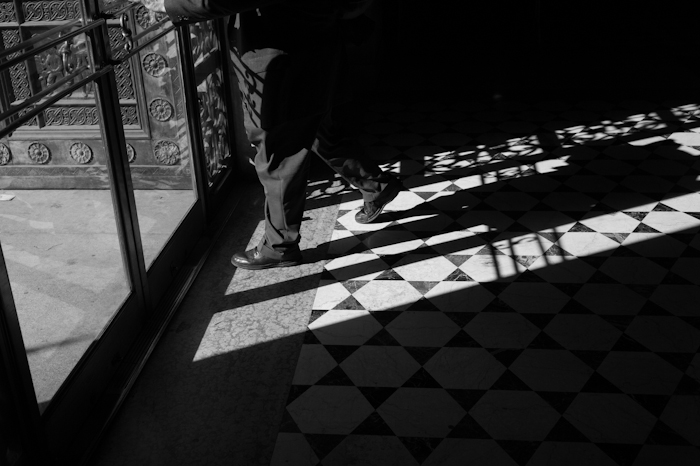
M9 Converted ISO 400, F6.7, 1/750 Sec, 50mm Summilux

The last four times I went out shooting, I came back with nothing worth looking at. O and my fellow street photographers had better luck than me. I was rather depressed, wondering when was I going to get out of this horrible slump? Then O told me about getting a Monochrome loaner. You can imagine how ecstatic I was. This was the camera that could take me out of the slump.

ISO 400, F16, 1/250 sec, 35mm Summilux

Once we had the camera in our hands, all we could think of was making the shot. But the pressure was huge to get something worth the privilege. We had limited time – two half days (we still had our day jobs to contend with and the availability of the camera was spur of the moment). So don’t expect major testing in this post although we did do a few.

ISO 400, F16, 1/125 sec, 35mm Summilux

O and I both shot with aperture priority ranging from F8 to F16 for exteriors and F1.4 to 5.6 for interiors. Unfortunately, when I loaded the images into Lightroom 4, the exposure information only registered the shutter speed but not the aperture (darn!). I hope this will be fixed with the updated firmware when the production models come out. I noted the F-stop when ever we were able to recall. The ISO’s vary and is noted with each photo. And generally, we zone focused every time.

ISO 160, F 8, 1/60 sec, 18 mm Super Elmar M

THE BASIC PHYSICAL

Let’s start with the physical characteristics: It’s effectively the M9-P. But the finish is a little different. The vulcanite on the M9 is replaced with a finer textured leather that’s nice to the touch. The metal is matte. There’s no logo or dot except for the tiny “Leica Camera Made in Germany” engraving on the back.
 The weight with battery is 600g (21 oz).
 The same as the  M9-P. I will talk about LCD screen, Menu, Frame Buffer, etc. as separate items below.

ISO 5000, F 5.6, 1/250 sec, 21mm Summilux

ISO BUMP

One of the newest and much awaited attributes of the Monochrome is the increase of the ISO range from M9’s highest of 2500 to Monochrom’s highest of 10,000. Leica didn’t change the 18 Megapixel M9 sensor made by Truesense (ex-Kodak), but it did change the parameters on what the sensor senses. Since color is no longer a concern, there is no need for the color filters that was added in front of the M9 sensor to help it recognize and record the color in light. I understand that other things like color value interpolators and artifacts no longer are of concern to black and white images. It’s really like taking away all the various layers from the sensor, allowing it to be its original naked self. So it shines when it is able to deliver full and high resolution without compromising for color.

ISO 10,000, F5.6, 1/2000 sec, 18mm Super Elmar M

It was a pleasure to take this camera around at night or in low light situations and be confident that we could shoot some photographs without bringing a flash or having to switch to our Ricoh GXR or Fuji X100. We had so much fun with the Monochrom, including having a few drinks so we could admire the design stripped of the decorations that the M9 or M9-P has. 🙂

ISO 10,000, F 5.6, 1/125 sec, 50mm Summilux

THE BEAUTY OF GRAIN

The most unique thing about this camera is the grain. The grain is just simply exquisite. The grain is not the digital hard edged type you get with the M9. It’s a soft film-like grain. I noticed noise starts to creep in after around 7-8000 ISO. Some reviews mention the optimal ISO is 5000. You can see below, at ISO 10,000, the grain does get a little muddy but I think still acceptable. I think the grain rendition alone is a reason for the Monochrome camera to exist.
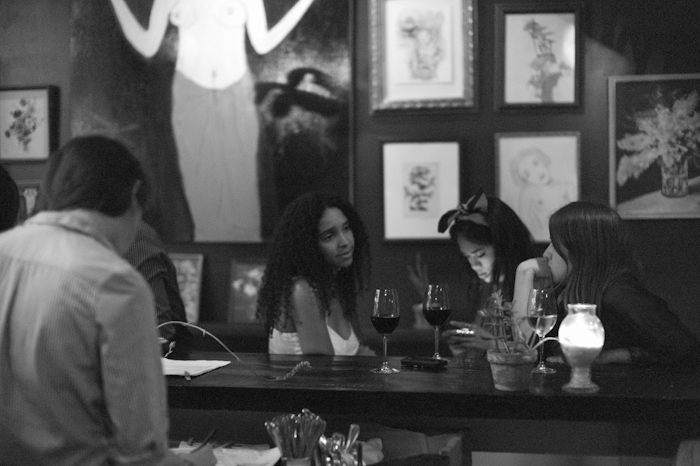
ISO 10,000, 1/125 sec, 50mm Summilux

TONES

The other most unique thing is the tonal value of the images. The blacks and grays are complex in range compared to the more contrasty M9. With the help of the new raw image data histogram, you can fine tune your exposure. The tones remind me of the way film responds.

ISO 5000, 1/180 sec, 50mm Summilux

FRAME BUFFER

At the beginning, Ebby warned us that the firmware was not ready so the preproduction model would be a little slow. He was right. The frame buffer still filled fast, slowing the computer down. After shooting continuous for 3 frames, the red light at the bottom of the LCD screen flashed for several seconds.
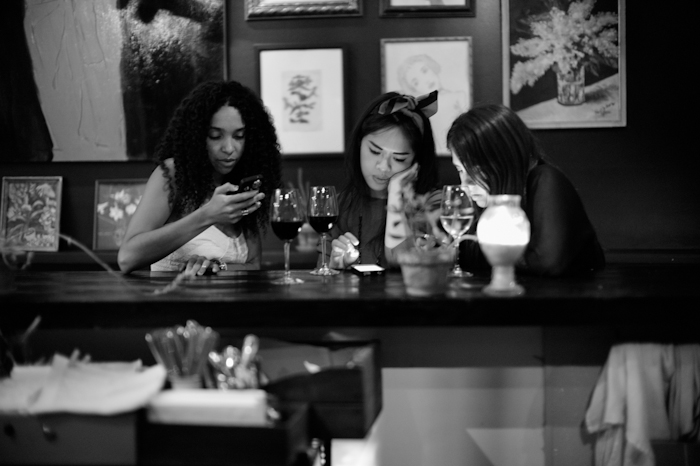
ISO 3200, 1/45 sec, 50mm Summilux 

While I could shoot a few additional frames, after about 6 to 8 shots the camera would not shoot anymore and I had to wait before I could resume. I am assuming Leica will have this part resolved by the time they deliver the production model.
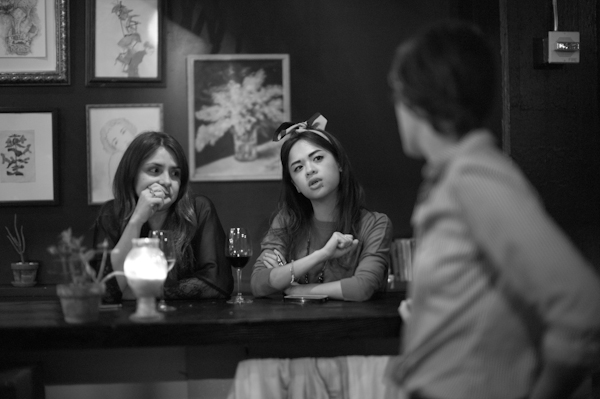
ISO 3200, 1/60 sec, 50mm Summilux
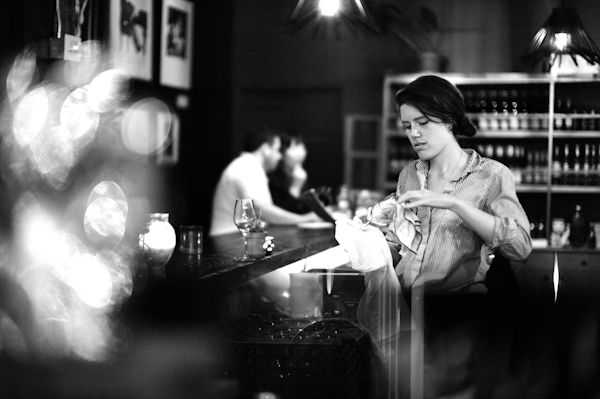
ISO 3200, F 1.4, 1/125 sec, 50mm Summilux

EXPOSURE

If you like to shoot with perfect exposure on the subject and allow the brights to blow out and over expose, then you’ll have to adjust the way you shoot. In the photo above, I center metered on Caitlin, the bartender and thought the shiny object on the left would not blow out. And the photo below, I center metered on the bread and not the light in this photo and both were mistakes.

ISO 3200, F 1.4, 1/180sec, 50mm Summilux

Had I anticipated this problem, I would have brought along my M9 or any color camera, film or digital. But, one always learn from hindsight. 🙂

This camera is best used with exact or under exposed shots. Over exposed shots do not have enough information for recovery in Lightroom. Believe me, I pushed every lever in Lightroom hoping to dig some detail out of the blown out areas and never found any, unlike images shot with the M9.

ISO 10,000, F 8, 1/1000, 18mm Super Elmar M

LCD SCREEN

The 2.5″ TFT LCD with sapphire-crystal Display screen is still the same ridiculously cheap one as the M9-P. I always struggle with focus in low lighting as you can see here despite the ‘bright-line frame viewfinder. I had hoped that since there is more data information from the Monochrom sensor, the screen would also show more detail for when I proof my focus. Unfortunately, that is not the case.

Monochrom ISO 400, 1/45 sec, 35mm Summilux

M9 Converted ISO 400, F 2.4, 1/60 sec, 50mm Summilux (see how the sensor is struggling with low light at the same ISO)

THE MENU
The Menu is basically the same as the M9 and M9-P except for:
1) The added the high ISO range.
2) The elimination of white balance used only with color.
3) A new histogram display to show the raw data combined with a clipping display. You can fine tune and optimize your exposures.  I really didn’t have time to play with this feature.

ISO 400, 1/60 sec, 35mm Summilux

RETHINK HOW YOU ‘SEE’ 

What I realize about this camera is that you have to think differently. You have to think black and white. I was frustrated several times because I saw a scene in color and when I shot it, the image did not have the meaning or punch that color would have given me. And I didn’t always have O beside me to shoot the color version. And nor did he have me all the time to shoot the color version when he was shooting the Monochrom.

Monochrom ISO 2500, 1/45 sec, 35mm Summilux (I didn’t meter this properly so you can see, the horizon is blown out and details of the distant mountain seen in the color is lost)

Since we see in color, you have to train yourself to see in black and white.  And when I use my M9, I never shoot in monochrome or view the jpeg in monochrome. I always view in color first.
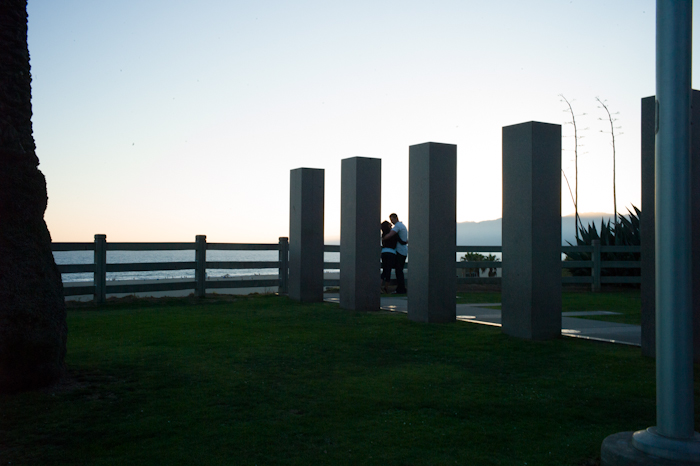
M9 ISO 1250, F13 , 1/125 sec 50mm Summilux

The other thing is you have to know the camera inside and out. You can’t be cavalier about your exposure like you would with normal color digital cameras, M9 included. The camera demands you to be more precise about what you capture in-camera as that is how it appears to be designed. Treat it like a film camera where post options are limited compared to the typical color digital camera. But you have the luxury of not having to wait for the development time of film.

ISO 400, 1/180 sec, 35mm Summilux

Professionals and amateur who normally shoot in black and white will find it easy to use. However for us, the two days O and I had the camera was not enough to wrap our heads around it. So please excuse the quality of the photography.

ISO 400, 1/60 sec, 35mm Summilux (This image is completely unprocessed-raw except that it’s a jpeg-raw)

THE PRICE TAG

At a cool US$7,970 +/- for just the body, not including taxes, the price hits you where it hurts. That’s US$1,000 more than the M9 or the same as the M9-P and you don’t have the flexibility of shooting both color and black & white. If you want the option, you’ll have to bring another camera, defeating the concept of traveling light. I wish it was at least the same cost as the M9 and not the M9-P.

ISO 400, 1/45 sec, 35mm Summilux

CONCLUSION

So what do I think about this camera? It’s funny how things take left turns in life. When Leica announced the Monochrom back in May, I was very skeptical. I thought: who would want to shoot with a dedicated camera when you have the ability to shoot color and then convert it? I also thought: who would spend so much money on a dedicated camera?
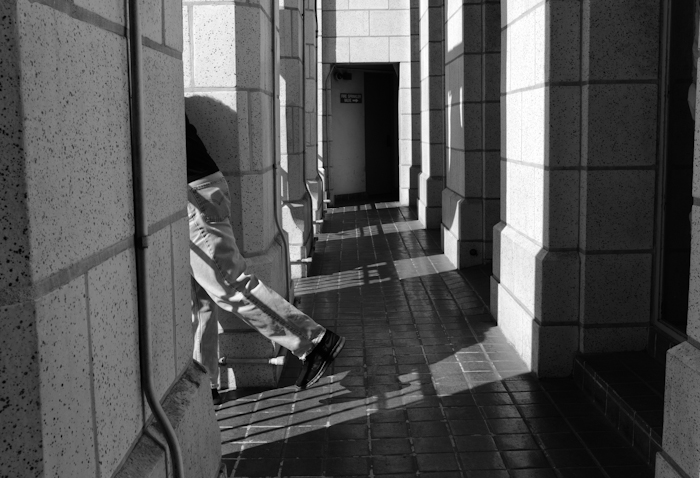
Monochrom ISO 400, F11, 1/125 sec, 35mm Summilux

The more I read about it, the more interested I became in this camera. Now that I have played with it, I can honestly say, I want to spend more quality time with it because I love it. I agree with the concept that it is the photographer’s eye and not the camera that makes the images. But we all pore over countless photobooks for inspiration, right? And now, the images that the great masters shot on black and white  film no longer seem so unattainable. I don’t mean to be presumptuous, but the desire to try to shoot amazing photos using the masters as a standard to aim for, is exponentially intensified when I use the Monochrom.
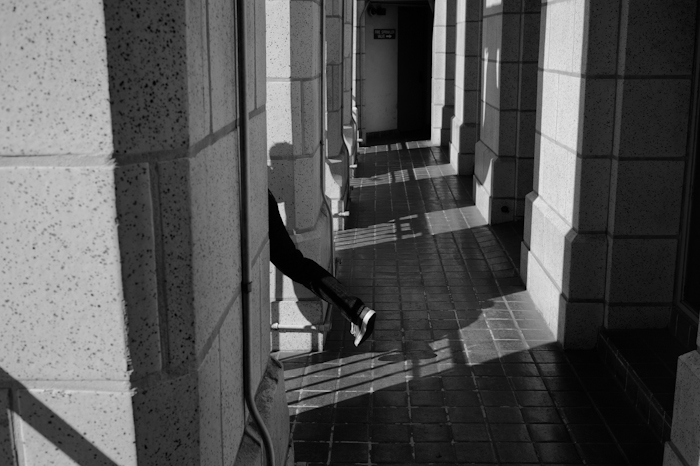
M9 Converted ISO 400, F8, 1/750 sec, 50mm Summilux

O is completely sold on this camera. He says he is already imagining the cool shots he can make with it. While we shoot with our M9 or Ricoh or whatever, O and I talk about shots that we could make with the Monochrom. Isn’t that the beginning of aiming to shoot better photography?

ISO 400, F16, 1/60 sec, 35mm Summilux

As the Monochrom is pricey, we have already sold various things,  just to make room for this little baby. And we can’t wait to get it and go out shooting with it. 🙂

I like to think that the Monochrom is much like the Levitated Mass by artist Michael Heizer  you see below. It’s something bold and ‘out-of-the-box’ to look at in wonderment. In the case of the Monochrom, you’re in luck. You can also use it with wonderment. 🙂

ISO 160, 1/125 sec 18mm Super Elmar M

I’ll be posting part two with a variety of images- architecture, landscape, and of course, street within the next two weeks. So keep a look out for it!!

UPDATE: AUGUST 17, 2012, I posted Part 2 here.

Todd Hatakeyama’s Micro Lens Pouches


Since our launch back at the end of March, Leica Liker reviewed products without the request of a manufacturer. This time the call came from my friend Todd Hatakeyama to review his Micro Lens Pouches. He’s the owner of Hatakeyama Gallery, a small gallery in Los Angeles, supporting local street photographers by providing exhibition, learning and hangout space. He also owns Simple Studio Lighting, an affordable lighting supply store. I mentioned him in my post reviewing Steve Huff’s Los Angeles workshop where he was sponsor and co-host.

Todd is a big Leica fan. He’ll buy every gadget imaginable to baby and outfit his prized possessions. So when he looked for pouches for his Leica lenses, he found large ones made for SLR lenses. Or poor quality, thin nylon bags. But there was nothing out there made specifically for smaller Leica lenses. So what did he do? He developed and manufactured pouches to satisfy his own needs.

The Micro Lens Pouches are simple in design. Sleek utilitarian to be exact. No fuss. The material itself is cushiony similar to the feel of wetsuits or ski jackets. The nice part is that it’s not a nylon bag with foam inserts. It’s a material where the structure itself is cushiony. When I asked for the specifications on the material, Todd told me it was a “secret material”, made in Taiwan.

I did abuse a pouch for this review and it held up. It does a good job of protecting your lenses when you stuff them into a bag with other things. Though, if you forcefully threw it like a baseball, I doubt your lens would be fully protected. I poured water on it too. It’s water resistant but it is not water proof.

The prices on the web site are a little more than if you bought them through Amazon. Todd told me he made a deal with them for a limited amount. So if you’re looking for something to protect your lenses or small fragile things, you might want to consider Micro Lens Pouches. You can check out their website for more information here. Or go directly to the Amazon website here.

Steve Huff’s Los Angeles Workshop 2012; SLR Magic Hyperprime 50mm F 0.95 Noktor Lens

Back in January, I had the chance to attend Steve Huff’s Workshop in Los Angeles. I also had a chance to play with the SLR Magic’s Hyperprime 50mm F0.95 Noktor Lens for a couple hours. So this post will be a double fisted review of both!

I’m a fan of Steve Huff’s blog so it was exciting to hear from my friend Todd Hatakeyama, owner of Hatakeyama Gallery, that he was working on getting Steve to come to Los Angeles, to do a workshop. Then Steve actually announced it on his site and followed it up with another announcement that he needed ‘teachers’ or ‘presenters’. I quickly jumped at the chance and offered to present a short history, masters and basics to street photography. Much to my luck and surprise, Steve thought it was a great idea. It secured my spot.

Steve is as affable in person as he is on his blog. He and Todd put together a fun filled weekend of pure photography that involved presentations, hands on learning, shooting and sharing. It’s very different from the last post I made regarding Frank Jackson’s B & W class. There,  it was more the teacher – student relationship. Here, it was like going to photography camp.

To give you an idea, I thought I would just tell you what we did. So here goes:

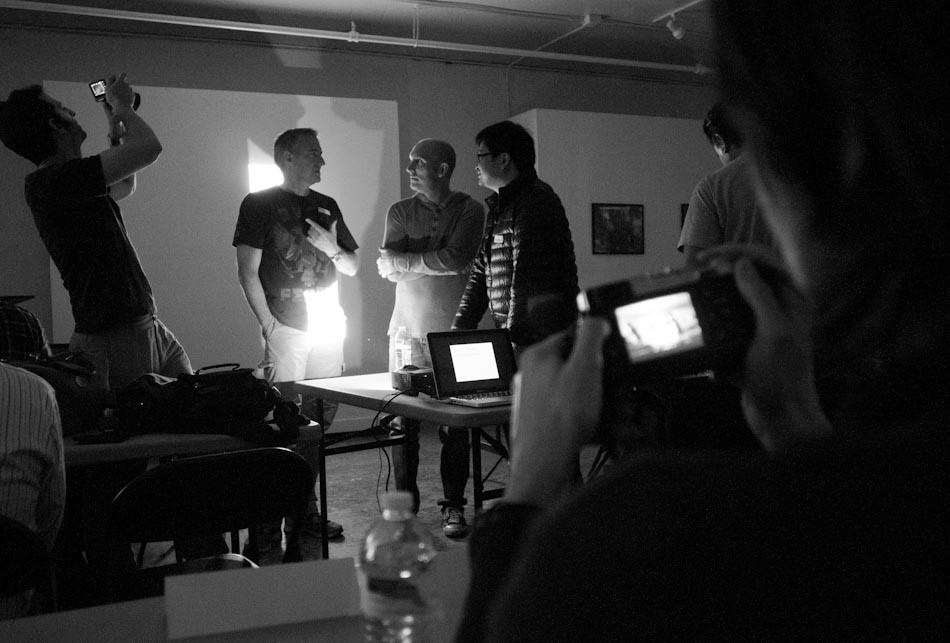
DAY ONE  started Friday, late afternoon with a meet and greet at Hatakeyama Gallery. Todd created a kind of “hot spot” or “home base” where photographers can gather and hang (there’s couches, TV and refrigerator :-)).  His gallery doubles as workshop space in the basement which is adjacent to studio shooting space. He’s working on expanding it to include a permanent workshop/classroom and dark room lab. You can also buy  basic lighting and camera equipment through his store,  Simple Studio Lighting, which occupies the main street level storefront. So basically a one stop photography environment.

30 attendees from around the country and Australia attended. Half of us had Leicas (film and digital) while the others had a variety ranging from Canons, NEX-7 to Fuji x100. It was also great to meet Ashwin Rao after reading his many posts.

The first presenter was Andrew Chan of SLR Magic, who introduced his new Hyperprime 50mm F 0.95 Noktor lens, the challenger to Leica’s Noctilux 50mm F 0.95. He brought 4 prototypes for the attendees to play with to get some feedback. And there were several points Andrew needed to fix which he said he would.

We took the lenses out for a spin around the neighborhood of downtown Los Angeles. Since it was night time, I decided to use the Ricoh GXR with the M-Mount to test out the Hyperprime.The results were pretty impressive.

Hyperprime on Steve’s M9-P

I shot the following two pictures just before we left for the walk to test the Hyperprime against the Noctilux. I did not edit the pictures. It’s just a jpeg of the raw images as is.

SLR Magic Hyperprime

Leica Noctilux

You can see, sharpness is pretty much on par between the two.  The colors of the Hyperprime are a touch on the blue and cool side. While the Noctilux has warmer tones. There is more contrast in the Hyperprime image than the Noctilux. Rendering for both look great.  The bokeh is lovely and smooth on both.

Photo by Ashwin Rao (See the Hyperprime on my Ricoh and on Steve’s Leica. Andrew is in the middle.)

I did notice that the Hyperprime lens was a touch loose on the M-mounting ring of my Ricoh. Andrew told me that it was quite normal. It did not affect the images. Although, I’m not sure if I felt better hearing that.

Physically, the Hyperprime is longer and heavier at 975 grams, than the Noctilux which weighs 700 grams. And I can personally attest to its ruggedness. While we were walking the streets the weight of the Hyperprime caused the standard issue Ricoh strap to loosen and the whole camera fell on the concrete pavement.  (Ouch!) When I heard the THUD, my heart stopped. I was horrified to say the least. It was loud enough that everyone came over to see that the thick lens hood took a small dent but the lens and camera was in perfect condition. Thank goodness, Andrew was all gracious and that it was a prototype and not a final production model. Luckily I didn’t have to pay for its replacement. 🙂

The Leica Noctilux Aspherical has 8 elements, 9 aperture blades and focuses to 1.0 meter.The

Hyperprime has 12 lens elements, 12 aperture blades and focuses to 0.7 meters ( equivalent of an f/0.92 aperture at f/0.95).

Andrew told me the Hyperprime glass comes from China as well as Schott in Germany because not all Chinese glass can perform at the their high quality expectations. However, the housing and all other materials come from China. They assemble in China and Hong Kong. To maintain quality control, the calibration is done entirely in Hong Kong. The combination helps keep the cost down and the quality up.

SLR Magic is committed to making this lens to work for many cameras other than Leica. So you can also get it with a Canon EF Mount, Nikon F Mount or Four Thirds Mount. But the coolest of all, the PL Cinema Mount. You can shoot this with movie cameras too!

Now, it’s hard for me to give a true verdict for the Hyperprime because I only had it for a couple hours. And from other people’s reviews of this lens, I can see the day time shots look pretty good. But at this point, I really still prefer the Noctilux. I hate to carry heavy elements, so the added weight and size of the Hyperprime is already a deterrent (every gram counts with me). However, I can say that if you can’t afford the Noctilux, the Hyperprime is an excellent alternative at half the price.

UPDATE: OCTOBER 8, 2012

Since my last update and updates by other blogs and websites, there has been quite a lot of commotion and out-of-context accusations in forums and Facebook regarding the causes, claims and remedies of SLR Magic’s 50mm F0.95 Hyperprime lens, which I gave a first impression review here. As a result, lots of finger pointing and heated exchanges have taken place between SLR Magic and some disgruntled test users regarding the pre-production models. So it’s time to update and hopefully put all issues to rest.

To provide an equal forum, I asked Andrew Chan at SLR Magic some pointed questions. He wrote back at length giving me detailed explanations. Here is Andrew’s response to my questions. I have only replaced names with initials:

1) So it is not clear to me, as there are different claims. Were the lenses that everyone in the tester program got, a pre-production model or a first short run production model?

Check the email you received before for the lens. All LA workshop lenses were pre-production lenses. Only D’s lens had a loose ring and only S’s lens had a mount that need to be replaced. Ever since their lenses the other customers have no loose ring issues or frame line issue. There was never a sho[r]t run production. It was just pre-production that had a stealth version then the production version that is either in green or in black.

2) You claim that some of the performance issues of the pre-production models were caused by poor packaging, which you have since changed- So, with the new packaging, do you have any more issues with loose rings and not focusing at infinity or any other problems?

The new packaging resolved all the issues. Only two people had issues with shipping. M’s was the first person who received the lens and we noticed the issue. We told D to wait since we need to improve the shipping materials but he said he will take a risk since he wants to use it to shoot a wedding that cannot wait. If we did not ship to him by his request there would have been no issues. T sent his lens to his buyer with no issues in our new packaging. We sent M his serviced lens that took one day turnaround time in the new packaging and he had no issues either.

3) So after the ‘testing’ period, have you resolved all of the lens problems? Can you say that your lens performs exactly how you and your team have envisioned it now?

The lens is performing fine. No one at Photokina had issues apart from three people. Two of them was due to human error as they cannot even constantly take accurate photos against a focus chart with Leica camera and Leica lens. The last person had a back focusing camera. He tested his own Voigtlander lens and Leica Camera. His lens is a 1.2 and a 35mm so there was more DOF and backfocus did not matter to him before. Someone did come with a Noctilux 0.95. His lens has very slight back focus that is within tolerance but he cannot constantly take photos on the spot with our chart. He was also comparing the Noct at 1m with the HyperPrime at 0.7m with different DOF properties.

The lens had always perform as we envisioned but what we did not expect was the amou[n]t of camera error and human error involved on the consumers end. When face to face we can test right on the spot. When by mail order it is difficult and with what everyone has read on the internet they automatically feel it is the lens that has issues.

Every lens returned has no focus issues. We have customers not using magnifiers for assist or needing to use diopters that may not be 100% perfect for their eyes and it is a difficult situation for us. To see clearly we need to stack two multipliers so it is impossible to shoot 100% accurate with no assistance. Erwin Putts also said to see 0.95 accurately it helps to have more than one magnifier.

4) When the customer wants a refund within a customary period, are you willing to refund?

Discounted Pre-production lenses had no refund policy as stated in the email. Regular customers may refund in one month only if there is a serious issue with the lens that cannot be repaired or exchanged. Reasons we received was I want to save up for the new Leica M instead, or bought three other Leica lenses this month, or my dealer called me and my Noctilux is in and I want to return, or I found a 50mm Summilux and I need money now. Those are NOT valid return reasons. The only one we felt was decent was he had an unexpected child and cannot afford to commit to the lens at this time. Strictly speaking that is not a valid reason but from the heart that is ok as it is a real financial situation. DA originally cancelled because all his gear was stolen and he need to use his money to get a new camera but he kept his order at the end by changing the LM order to CINE order. We tend to only accept cancellations or refund due to real urgency and not because of another Leica lens purchase. They can refund the Leica gear instead as it was the more recent purchase.

5) What is the expected turnaround in email correspondence between a customer and SLR Magic?

As F said, sometimes you cannot respond to everyone at once. That is totally true. We are a small company and apart from dealing with extremely complicated technical questions I also have to be in charge of the production line. Some on the internet complained we do not respond to emails. Many listed to him. Did he mention he emailed us at 11pm Hong Kong time on Sat and filed a complaint to us on Sunday afternoon? Those are not even our work hours. Leica in Hong Kong are closed on Sat and Sun as well. No one can respond so quickly. I have emailed S. K. from Leica before that is in charge of Leica Asia region. 4 months ago I emailed him and he said he is on business trip and till now there is no reply. The second time I emailed him was a week ago to order the Leica M and he did not respond to me ever and got another customer rep to reply to me a week afterwards. Even Leica company cannot reply immediately and they are a lot larger than us.

We usually respond in 1-5 business days depending on the difficulty of the question. If it is about Toy Lenses we respond in 1 day. if it is about RF lens then usually only I respond and it takes 5 business days. As you can see I typed a lot on facebook on this issue. I have over 28 emails with each Leica lens customer ever since the rumour mill.

6) Are you now selling the full production model?

Yes and we make the lens as a concept lens. We planned to have 10 lenses a month but ever since the rumor mill I was stuck with many emails to attend to and out lens makers were stuck with many people returning lenses for check up and re check up again that would not solve any issue as focus issues were due to human error and not lens error. The rumor mill caused a delay dropping production speed to 2-3 lenses per month only. Thus, S’ claim for dozens of people having issues is not possible as we don’t make so many lenses.

END UPDATE

UPDATE: July 14, 2012

Since my brief review of the prototype here, a series of first production models were bought by “testers” for around 60% of the retail price in exchange for feedback. And apparently, the lens has failed in its performance. I saw first hand a loose ring on a friend’s lens. And Facebook is now seeing many complaints regarding the len’s inability to focus at infinity in addition to loose rings.SLR MAGic has been blaming it on packaging in shipping, even when there was no shipping involved. Because of the commotion, Steve Huff, who raved unusually much about the lens and pushed for people to buy and check it out quite heavily on his site,  placed an update asking people to hold off on buying. Although, he says his lens is still okay. You can read his post here.

To add salt to the wound, the complaints don’t end with lens performance. It continues with bad or near non-existent customer service and rather nasty return policy for those who have cancelled pre-orders that have not shipped.

What a shame. SLR Magic is just ruining it’s potential as legitimate brand when it shuns its first most devoted and even forgiving customers. If SLR Magic wants to stay in business, it needs to do major damage control by  immediately offering full refunds to all those who cancelled pre-orders and provide a prompt and complete warranty service  or full refund option for those who already have it. In other words, SLR Magic needs to own up and suck it up.

END UPDATE


DAY TWO started off with a presentation by Jay Bartlett, a commercial portrait and fashion photographer here in Los Angeles. He gave us some basic tips on how to shoot portraits, followed by a hands-on studio model shoot. He brought in a professional model Jade Corinne, and professional make-up artist Marjorie Bartlett, who is also his wife (very handy). Jay was very cool. He explained to us why he set up the lighting the way he did and helped us to adjust our cameras to achieve the look we wanted. I had a ball shooting with strobes and a model. Everyone else did too.

I found out how difficult it is to shoot fashion  and models. The pose, facial expression and emotion is everything. But to get the model to look natural is really hard. So many of the shots I did made the model look like a manquin. The ones here are the best from a ton of shots.

Oh, and I finally learnt how to use my Sekonic light meter.  Thanks to Jay’s tutelage.

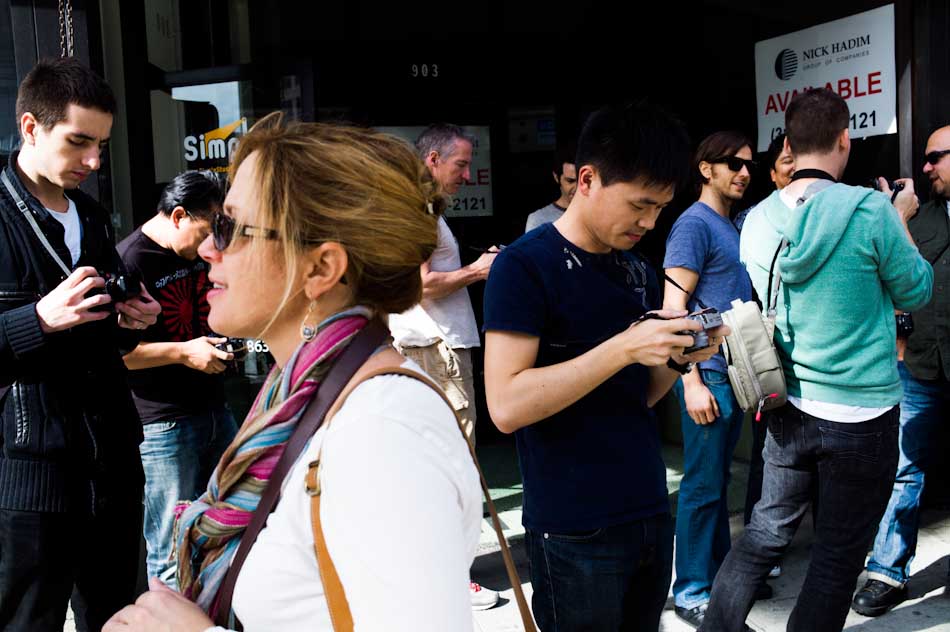
After the model shoot, we all walked a couple miles to Little Tokyo where we had a buffet lunch. Steve was a good host. You can ask about all sorts of photography questions and Steve gives you his opinion. We all sat together and talked ‘shop” and got to know the attendees as well. On the way there and back we got some street shooting in. This time I did not have the Hyperprime so others could try it out too.

We returned to the gallery to see a presentation of impressive work by Sean Armenta, another fashion photography based here in Los Angeles. It was followed by Ashwin Rao, who gave a talk about  how he built his on-line presence with examples of his photos. Afterwards, some of the attendees had dinner with Steve, but I had to take off. I heard they had a great time.

DAY THREE started with my presentation of the history of street photography, the masters, contemporary and the basics of street photography. And yes, I squeezed in a little shameless self promotion. 🙂 Jeff Garlin, the comedian/actor of Curb Your Enthusiasm fame, popped in early to listen to my presentation. Which he told me he liked by the way. 🙂  After my schtick, the true highlight of the day was when he did a “street photographer’s” stand-up routine for about 30 minutes. Everyone laughed their heads off. To all those who don’t know, Jeff is a huge street photography and a Leica fanatic. He is also a street photographer himself but is too shy to show his work. Hopefully he’ll reveal his art one day.  But for now, he is the producer of the Vivian Maier documentary which John Maloof will direct.

Jeff Garlin

After the laughs, we went to a Mexican restaurant nearby for lunch.  We shot some more on the streets and came back to the gallery to edit our photos. Then we presented our best 3 street images from the weekend. There was a lot of talent amongst the attendees, including first timers. Afterwards, some of the attendees went to dinner again with Steve. Looks like they had a good time.

The only complaint I have is that there was no water left after the first half of the second day and the third day. I know it’s a small, even petty thing but I had to run out and get water from the corner store up the street. I think it was because everyone got so involved into the workshop that it was simply forgotten.

Otherwise, I recommend this workshop to anyone who wants to get in on the know of new equipment, learn new techniques and be part of a street photography community.  I mentioned at the start of this post, it’s like going to photography camp. Like one big hangout. The only thing with this camp, there’s no sleep over. However, you make friends with a lot of like-minded people, who are all interested in the same thing as you. Community is really the most valuable thing you walk away with more than anything else. It’s like being a part of a club. In our case, we are now on Facebook as a group, constantly sharing and critiquing each other. Whenever there’s a question or some cool thing to share, we all get to see and talk about it. Steve is part of the group as well and puts in his two cents all the time. Even Andrew at SLR Magic is in the group. And whenever anyone wants to go shooting, we just post in FB that we’re in town and we meet up at Hatakeyama Gallery.

I’ve linked very one’s websites with their name if you wish to find out more info on them.